

ZAMBIA EXPLAINS
THE 24-YEAR-OLD WOMAN WHO DISCOVERED THAT A BETTER LIFE DOES NOT ALWAYS REQUIRE A BIGGER PAYCHECK
Article by Rodgers Mangwela | KASONDE24
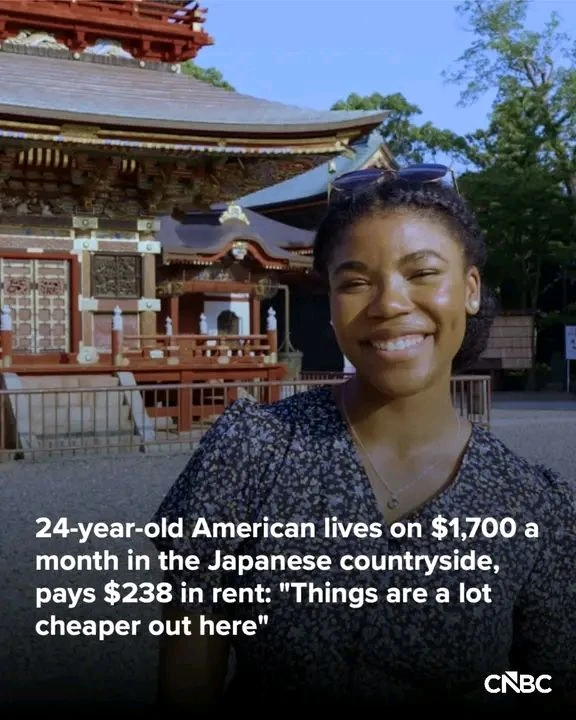
Imagine earning $1,700 a month, renting your own apartment for just $238, having your mornings free and enjoying a lifestyle that does not require working multiple jobs to survive. For many young people struggling with the rising cost of living, that sounds almost impossible.
Yet, this is the reality that 24-year-old American Lexi Smith says she has experienced after moving from Atlanta, Georgia, to the Japanese countryside.
Her story, reported by CNBC Make It on September 18, 2025, raises an important question: Are we sometimes chasing bigger salaries when what we really need is a better balance between income, expenses and quality of life?
Smith's experience is particularly interesting for young people in Africa, Zambia, Kabwe and Katondo, where the cost of housing, employment opportunities and financial independence remain important everyday concerns.
WHY SHE LEFT AMERICA
Smith's decision to relocate was not simply about travelling or satisfying her interest in Japanese culture. It was also about escaping a working environment that she felt was becoming increasingly difficult to sustain.
Before moving abroad, she worked as a teacher in the United States. However, she struggled with demanding working conditions, an administration she felt did not appreciate her efforts and a salary that was insufficient to comfortably support her lifestyle.
She sometimes worked at two schools simultaneously, spending between 10 and 12 hours a day at work. There were occasions when she struggled even to find time for ordinary necessities such as taking a bathroom break.
Eventually, she began exploring opportunities to teach English overseas.
Through an organisation called Xplore Asia, she obtained a Teaching English as a Foreign Language (TEFL) certification and started looking for employment opportunities abroad.
Her search eventually took her to Japan.
A $238 APARTMENT IN THE JAPANESE COUNTRYSIDE
Smith settled in Chiba Prefecture, a region east of Tokyo, where the environment is considerably different from the busy atmosphere of Japan's capital.
Instead of crowded city streets and expensive urban accommodation, she found herself surrounded by rice fields, quieter neighbourhoods and a slower pace of life.
Her one-bedroom, one-bathroom apartment costs approximately $238 per month, equivalent to 35,000 Japanese yen.
The accommodation includes a balcony and basic facilities suitable for independent living.
Interestingly, her employer helped arrange the apartment before she arrived in Japan. The company also assisted with certain relocation expenses, including key money, a non-refundable payment traditionally associated with renting property in Japan.
She did not have to pay a security deposit, and her employer covers her fire insurance.
She also pays approximately $100 monthly for a car.
This arrangement demonstrates an important aspect of international employment: sometimes the value of a job extends beyond the salary itself. Accommodation assistance, insurance and relocation support can significantly reduce the financial pressure on an employee.
HOW SHE SURVIVES ON $1,700 A MONTH
According to CNBC, Smith earns approximately 250,000 yen, equivalent to $1,700 monthly at the exchange rate used in the September 2025 report.
She works at an eikaiwa, a private Japanese language school specialising in conversational English.
Her working hours are generally between 3 p.m. and 8 p.m. She teaches approximately five to seven classes daily, with students ranging from three-year-old children to adults aged 73.
Most lessons are conducted individually or in groups of two and last between 30 and 40 minutes.
One of the biggest differences she has experienced is the freedom to organise her mornings.
Instead of rushing to work early and spending most of her day inside a classroom, she has several hours available for personal activities before her afternoon lessons begin.
Her reported monthly expenses for water, gas, electricity, health insurance and groceries amount to approximately $376.
Combined with her $238 rent, these expenses total around $614, excluding her car payment and other personal spending.
It is important to understand that these figures reflect Smith's individual circumstances, including the support provided by her employer. They should not be interpreted as a universal cost of living for everyone in Japan.
THE CHALLENGES BEHIND THE BEAUTIFUL LIFESTYLE
Moving to another country can look exciting on social media, but building a life somewhere unfamiliar requires courage, patience and preparation.
Smith moved to Japan without knowing the language or having an established personal network there.
Although her colleagues helped her settle in, the language barrier remains one of her biggest challenges.
Her employment environment is largely English-speaking, which means she has fewer opportunities to practise Japanese in everyday situations.
She also had to adjust to a different culture, unfamiliar surroundings and the experience of living far away from her family.
Her story reminds us that affordable accommodation and a comfortable working schedule do not automatically eliminate the emotional difficulties associated with migration.
There is also the question of how long such an arrangement can last. Smith's reported employment arrangement was initially for one year, and she expressed plans to return to the United States after completing her contract.
In other words, her Japanese experience was not necessarily a permanent relocation.
WHAT CAN ZAMBIA AND AFRICA LEARN FROM HER EXPERIENCE?
For young people in Zambia, particularly those living in Kabwe, Katondo and other communities outside Lusaka, Smith's experience offers several lessons worth considering.
First, income should not be the only measure of financial success. Someone earning a relatively modest salary but spending less on accommodation and transportation may enjoy greater financial stability than someone earning more but carrying heavy monthly expenses.
Second, skills can create opportunities beyond geographical boundaries. Smith's teaching qualification and TEFL certification helped her access employment in another country.
For Zambian teachers, graduates and other skilled young people, developing internationally recognised qualifications, learning foreign languages and understanding legitimate overseas employment opportunities can open additional career pathways.
Third, employers have a responsibility to consider the welfare of their workers. Smith's experience highlights how accommodation assistance, insurance and reasonable working hours can improve an employee's quality of life.
However, there is another important lesson: moving abroad should never be treated as an automatic escape from economic difficulties. International employment requires research into visa requirements, employment contracts, taxation, healthcare, cultural expectations and the actual cost of living.
Young Africans should also be cautious of fraudulent recruitment agencies promising overseas jobs in exchange for large upfront payments.
THE REAL MEANING OF A BETTER LIFE
Perhaps the most interesting part of Smith's story is not the $238 rent or the $1,700 monthly salary.
It is the discovery that a person's quality of life can change dramatically when their working environment, living expenses and personal time become more manageable.
For years, many people have been conditioned to believe that success means moving to a big city, earning a large salary, owning expensive things and maintaining an increasingly demanding lifestyle.
But Smith's experience challenges that thinking.
A quiet home, manageable expenses, meaningful employment and enough time to enjoy life can be just as valuable as a prestigious job title.
For Africa, and particularly for Zambia, this raises an important development question: How can our communities create environments where young people can earn decent incomes, access affordable housing and build meaningful lives without feeling compelled to leave their countries?
Perhaps the future is not simply about encouraging everyone to move abroad. It is also about building communities at home where opportunities and a decent quality of life are possible.
Sometimes, the biggest upgrade in life is not earning more money. It is learning how to live better with what you earn.
published by KASONDE24




















Comments