

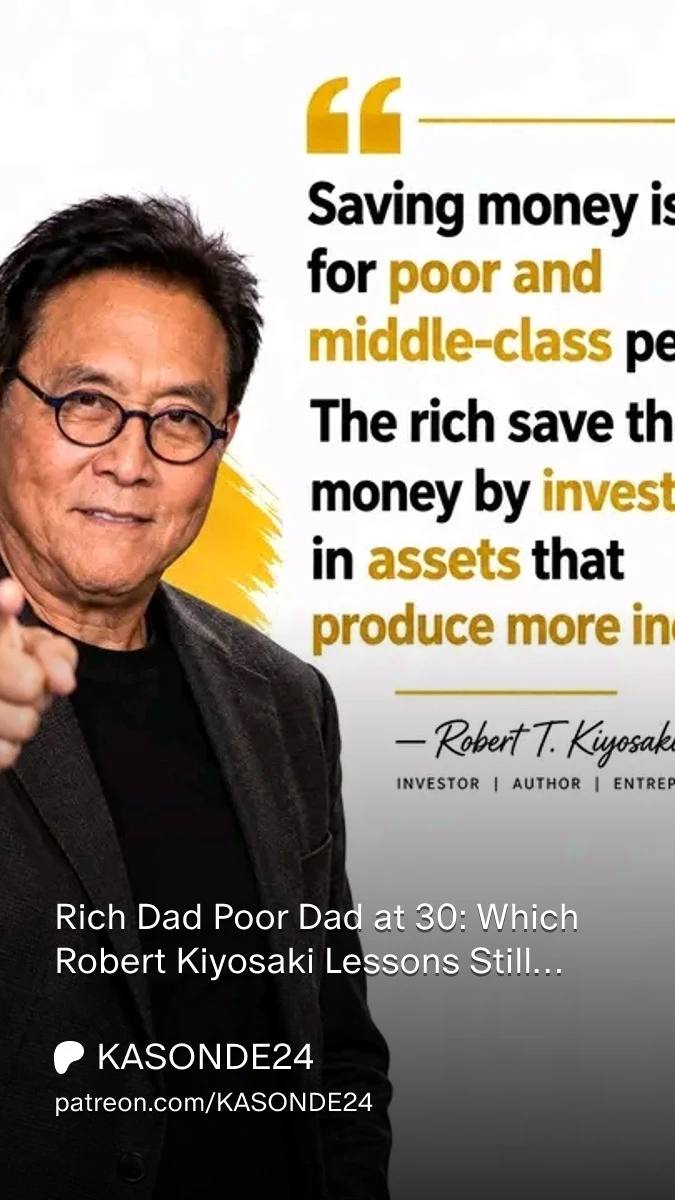
Rich Dad Poor Dad at 30: Which Robert Kiyosaki Lessons Still Work in the Age of AI?
Author: Rodgers Mangwela
Imagine spending your childhood being told that the safest road to a good life was straightforward: go to school, study hard, find a respectable job, work for decades, save some money and eventually retire. For generations, this formula has been presented as common sense, and for many people it has provided a perfectly respectable path through life. But then Robert Kiyosaki published Rich Dad Poor Dad and invited millions of readers to look at that familiar formula through a completely different lens.
The book became famous because it challenged assumptions that many people had never thought to question. Kiyosaki encouraged readers to think about financial education, assets, liabilities, entrepreneurship and the difference between working for money and learning how money works. When the book first appeared, the world was only beginning to understand how dramatically the internet would transform business and employment.
Nearly three decades later, another technological revolution is underway. Artificial intelligence is moving into offices, classrooms, factories, businesses and creative industries, raising difficult questions about the future of employment and the value of different skills. That makes one question particularly interesting: if Kiyosaki's financial philosophy challenged the traditional employment mindset in the 1990s, what can we learn from it in an economy increasingly shaped by AI?
The answer requires more than simply repeating the slogans associated with Rich Dad Poor Dad. It requires looking at the underlying ideas and asking how they fit into today's economic reality.
The world that produced Rich Dad Poor Dad has changed
When Rich Dad Poor Dad became a global phenomenon, social media had not yet become part of everyday life, smartphones were not controlling people's working and social lives, and artificial intelligence was still largely associated with research laboratories and science fiction.
Today, someone with a laptop and an internet connection can potentially reach customers thousands of kilometres away. A teacher can publish educational materials online, a musician can distribute music internationally, a programmer can work with clients in another country, and a small business owner can use digital tools to perform tasks that previously required several employees.
Artificial intelligence is accelerating this transformation. The World Economic Forum's Future of Jobs Report 2025 says technological change is one of the major forces expected to reshape employment through 2030. Its survey of employers representing more than 14 million workers projects significant job creation alongside substantial job displacement as economies and technologies change.
That does not mean that everybody will lose their job to a machine. The reality is much more complicated. Some occupations will change, some tasks will become automated, new occupations will emerge and many existing jobs will increasingly require people to work alongside technology.
This is where one of Kiyosaki's broader ideas becomes relevant: people need to understand the economic forces affecting their ability to earn money.
The paycheck is not the enemy
One of the easiest ways to misunderstand Rich Dad Poor Dad is to conclude that having a job is somehow a financial failure. That is not a useful interpretation.
Employment remains an important source of income and stability for millions of people. Doctors, teachers, engineers, nurses, accountants, technicians, civil servants and countless other professionals provide services that societies depend upon. A salary can help someone pay bills, support a family, save money and invest for the future.
The more important question is what happens beyond the paycheck.
If a person's entire financial life depends on one employer and one source of income, a major change in the workplace can create serious difficulties. The rise of AI makes this issue more visible because technology can change the demand for certain skills surprisingly quickly.
The World Economic Forum estimates that a significant share of workers' existing skills could change by 2030, while technological literacy, AI and big-data skills, creative thinking, resilience, flexibility and lifelong learning are among the capabilities expected to become increasingly important.
In that environment, learning cannot be treated as something that ends when a person leaves school. It becomes part of financial survival.
Your knowledge can become an economic asset
Kiyosaki's discussion of assets has traditionally encouraged readers to think about things that can produce income rather than simply consume it. In today's digital economy, that concept can be extended into areas that were barely imaginable when the book was written.
Consider a songwriter who creates music and retains ownership of the rights. Consider an author who publishes a book that can continue reaching readers years after it was written. Think about a programmer who develops software that can be used by thousands of customers, or an educator who creates an online course that reaches learners beyond the walls of a classroom.
These activities do not guarantee financial success, and it would be irresponsible to pretend that they do. Building something valuable requires time, research, marketing, persistence and an understanding of what customers actually need.
Nevertheless, they demonstrate an important shift in the modern economy. A person is no longer limited to thinking about wealth only in terms of physical property or a monthly salary.
Knowledge, intellectual property, digital products, audiences, brands and useful skills can also create economic opportunities.
AI gives the small entrepreneur a new set of tools
Perhaps the most fascinating development since Kiyosaki wrote Rich Dad Poor Dad is the arrival of widely accessible artificial intelligence.
A small entrepreneur who once needed to hire several specialists for certain tasks can now use AI-assisted tools for activities such as brainstorming, research, drafting, data analysis, customer communication, coding and content development. That does not eliminate the need for human expertise, but it can change the cost and speed at which an individual can experiment with an idea.
For a young entrepreneur in Zambia, this could be significant. Someone building a small business does not necessarily have the financial resources of a multinational corporation. Digital tools can potentially allow that individual to research markets, improve communication, create promotional materials and reach customers beyond their immediate geographical location.
The opportunity, however, comes with an important warning. AI is a tool, not a business model. Simply using an AI application does not create value. People still need to understand customers, solve genuine problems, make sound financial decisions and build trust.
Technology can make certain activities easier, but it cannot remove the need for judgment.
What Kiyosaki's message could mean for African youth
This discussion becomes particularly important when viewed from the perspective of young Africans entering rapidly changing economies. For decades, many young people have been encouraged to think primarily about obtaining formal employment. Education has often been presented as the road to a certificate, and the certificate as the road to a job.
There is nothing wrong with wanting employment. The challenge comes when young people are taught to believe that employment is the only possible definition of economic success.
A young Zambian might be a teacher and also write educational books. A musician might earn from performances while developing intellectual property. A farmer might produce crops while building a value-added agricultural business. A student might acquire digital skills and eventually provide services to clients outside Zambia.
These possibilities should not be romanticised. Entrepreneurship is difficult, and many businesses fail. Building multiple income streams takes discipline, knowledge and patience. But the ability to identify opportunities beyond one traditional career path can make a person more adaptable.
This is one reason the mission of Openlearnzambia is particularly relevant to the modern conversation about financial literacy and opportunity. Education should not simply prepare people to pass examinations. It should help them understand a changing world and develop the ability to keep learning when that world changes again.
Financial education matters more when technology moves faster
There is another important lesson hidden beneath the arguments surrounding Rich Dad Poor Dad: people cannot make sensible financial decisions if they do not understand basic financial concepts.
A person may earn a large salary and still struggle financially if spending continually rises alongside income. Another person with a modest income may gradually build financial stability through disciplined budgeting, saving, responsible investing and careful business decisions.
AI does not change these fundamentals.
In fact, it may make financial literacy even more important because technological change is creating new opportunities as well as new risks. People will encounter investment claims, online businesses, digital products and financial information at a speed that previous generations never experienced.
The ability to distinguish an opportunity from a risky proposition therefore becomes increasingly valuable.
The biggest lesson may be adaptability
Perhaps the most useful way to revisit Rich Dad Poor Dad today is not to ask whether every statement in the book remains universally applicable. Instead, we can ask whether its central encouragement to become more financially educated still has relevance.
The answer lies partly in what is happening around us.
The World Economic Forum's research suggests that employers expect major changes in the skills they need during this decade, with AI and big data among the fastest-growing areas while human capabilities such as analytical thinking, creativity, resilience and lifelong learning remain important.
That combination tells us something important about the future.
The most valuable worker may not simply be the person who knows how to use AI, nor the person who has decades of experience without updating their skills. Increasingly, the advantage may belong to people who can combine technology with judgment, creativity, communication, financial understanding and the willingness to learn.
That is a much more useful lesson than simply telling everyone to become an entrepreneur.
So, does Rich Dad Poor Dad still matter?
Nearly three decades after its publication, Rich Dad Poor Dad remains part of the financial conversation because it encouraged ordinary readers to question assumptions about money and work. But today's reader has a different world to navigate.
AI is changing the workplace. Digital platforms are changing entrepreneurship. Education is becoming increasingly accessible online. Businesses can reach global customers from surprisingly small beginnings, while technology can also make some traditional skills less valuable.
The lesson for today's generation is therefore not to abandon the traditional path blindly. It is to avoid becoming completely dependent on any single path.
Keep learning. Understand money. Develop valuable skills. Use technology intelligently. Build things that provide genuine value. Protect yourself from unrealistic promises of quick wealth, and remember that financial independence is normally built through decisions repeated over many years rather than through one spectacular breakthrough.
For readers discovering these ideas through Openlearnzambia, and for the wider audience following entrepreneurship, education and economic opportunities through KASONDE24, that may be the most important message of all.
Kiyosaki wrote about financial freedom in an age when the internet was still young.
Today's generation is entering an age when artificial intelligence can potentially change the value of a skill, a job or even an entire business model within a few years.
The question is no longer simply whether you work for money or make money work for you.
The bigger question is whether you are continuing to learn fast enough to remain valuable in a world that refuses to stand still.
Author: Rodgers Mangwela













Comments