

TALKING MOVIES
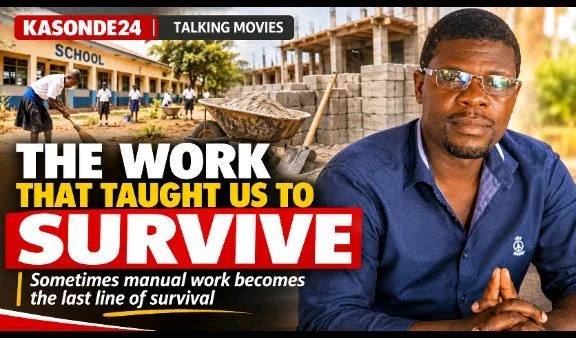
SOMETIMES MANUAL WORK BECOMES THE LAST LINE OF SURVIVAL IN LIFE
Article by Rodgers Mangwela | KASONDE24
The Lessons We Never Knew We Were Learning
Sometimes, the education that saves your life is not the one you receive inside a classroom. Sometimes, it is the education that makes you sweat, gets your hands dirty and teaches you how to survive when everything else falls apart.
I grew up and went to school during an era, particularly between 1993 and 2005, when manual work was an ordinary part of school life. We swept classrooms, cleaned schoolyards, watered flowers, cultivated gardens and participated in various school maintenance activities. Sometimes, we were instructed to report to school carrying hoes, brooms and water containers. Even during holidays, schoolwork could find its way into our schedules.
To pupils of my generation, these activities were not always exciting. Many of us hated them. We questioned why we had to work when we had come to school to learn. Little did we understand that some of the lessons being planted in our young minds would only become meaningful many years later.
Chindwin B: Where the Lessons Began
One of the teachers I remember from my early school days was my late teacher, Mr Njalamimba, at Chindwin B.
He would take us for Agriculture lessons, where every pupil had a vegetable bed to water and look after. I was only in Grade Four at the time. At that age, gardening felt like another responsibility imposed on children who would rather be playing.
But those activities introduced us to something important: responsibility, patience, discipline and the satisfaction of working with our hands.
We were learning that something valuable could come from the ground if we invested time and effort in looking after it.
Mulungushi Agro: The School That Made Us Sweat
If there was someone who represented school working activities during my years at Mulungushi Agro, from primary school through junior and senior secondary education, it was Mr Muleya.
He could make you sweat like there was no tomorrow!
We planted banana plantations, cultivated school fields, slashed grass beyond school boundaries and participated in activities that helped maintain and improve the school environment.
Some of our experiences went beyond ordinary school cleaning. We helped ferry construction materials for the development of the current Mulungushi Agro Secondary School. We cleaned the construction site and helped make the surroundings presentable.
One experience remains particularly memorable.
We crossed the dry Mulungushi River carrying heavy metal window frames from Mulungushi Basic School to the new school construction site. It was physically demanding work, involving a walking distance that, in my memory, felt comparable to travelling from Kabwe town to Katondo.
Imagine young pupils undertaking such physically demanding activities!
At the time, we were simply children trying to survive another day of schoolwork. We did not understand the bigger picture. We only knew that Mr Muleya expected us to work, and somehow, we had to find the strength to do it.
Looking back, I cannot separate those experiences from the person I eventually became.
When the White-Collar Dream Meets Reality
For many young Africans, education has traditionally been presented as the gateway to a comfortable life. Go to school, obtain qualifications, find employment, wear formal clothes and eventually secure financial independence.
There is nothing wrong with aspiring to a professional career. Education remains one of the most powerful tools for personal and national development.
However, life does not always follow the script we were given.
The promise of a white-collar job can become a distant dream. Opportunities disappear, businesses collapse, privileges vanish and circumstances change. Sometimes, the qualifications you worked so hard to obtain cannot immediately put food on your table.
That is when life introduces you to another classroom.
I experienced this reality personally.
At one of the lowest points in my life, I found myself working in construction. I was making concrete, pushing wheelbarrows, offloading truckloads of cement, carrying building blocks and undertaking agricultural work.
These were not the circumstances I had imagined for myself.
The professional and intellectual skills I had spent years developing were not enough to solve my immediate challenges. I needed something more practical. I needed physical strength, endurance, discipline and the mental preparedness to undertake work that was uncomfortable and exhausting.
And that is when memories of my school days came back.
The hoes, the gardens, the banana plantations, the construction materials and those demanding activities at Mulungushi Agro suddenly made sense.
What we once considered punishment had become part of our survival toolkit.
Are We Preparing Today's Children for the Real World?
This brings me to an important question about the education system in modern Zambia.
Are we adequately preparing children for the practical realities of life?
I sometimes look at the school experiences of today's pupils, particularly in some private schools, and wonder whether we have gone too far in protecting children from ordinary responsibilities.
Some pupils grow up without being expected to sweep their classrooms, pick up litter, water flowers or participate in simple school gardening activities.
Of course, not every school operates this way, and children must never be subjected to dangerous, excessive or exploitative labour. Their education, safety and dignity must always come first.
However, there is a difference between exploiting children and teaching them responsibility through age-appropriate practical activities.
A child who learns to clean a classroom is not being denied education. A child who waters flowers is learning to care for the environment. A child who participates in a school garden is gaining practical agricultural knowledge.
These are lessons that can complement academic education rather than compete with it.
Parents also have a role to play. Sometimes, in our desire to give children a better childhood than the one we experienced, we remove responsibilities that could help prepare them for adulthood.
We want them to have comfortable lives, but comfort should never come at the expense of competence.
Education Must Prepare Us for More Than Employment
Africa needs educated people, but it also needs people who can work with their hands, solve practical problems, build things, grow food and adapt when circumstances change.
In Zambia, where unemployment and economic uncertainty remain important challenges, practical skills should be treated as an essential part of education.
A university graduate should not feel ashamed of working in construction. A teacher should not consider farming beneath their qualifications. An office professional should not be helpless when circumstances demand physical work.
There is dignity in honest labour.
The ability to adapt, regardless of where life takes you, is an education in itself.
My experience has taught me that no honest skill is useless. The hands that once held a pen can also hold a hoe, push a wheelbarrow, mix concrete or build something meaningful.
Today, I Understand What They Were Preparing Us For
I am happy that the education of my generation exposed us to practical work. I am grateful to the teachers who made us sweat, even when we thought they were being unnecessarily demanding.
I remember the late Mr Njalamimba and the vegetable beds at Chindwin B. I remember Mr Muleya and the demanding working activities at Mulungushi Agro.
I cannot claim that every activity we undertook was perfect or that every approach to school manual work was appropriate. But I can confidently say that those experiences contributed something valuable to my life.
Years later, when circumstances stripped away some of the privileges and expectations I had attached to education, my hands were still useful.
Perhaps that is one of the greatest lessons we can pass on to the next generation: Teach children to pursue their dreams, but also prepare them to survive when those dreams take longer than expected to materialise.
Because life does not always ask for your certificates.
Sometimes, it asks what you can do with your hands.
And when that moment comes, the practical lessons you once hated might become the very things that keep you standing.
published by KASONDE24

















Comments