

🐍 Python Walrus Operator (:=) | Write Cleaner Code in One Line! ⚡
🔥 Did you know Python has an operator that lets you assign a value and use it immediately in the same expression?
Meet the Walrus Operator :=, one of Python's useful features that can make your code shorter, cleaner, and more readable.
💻 Example:
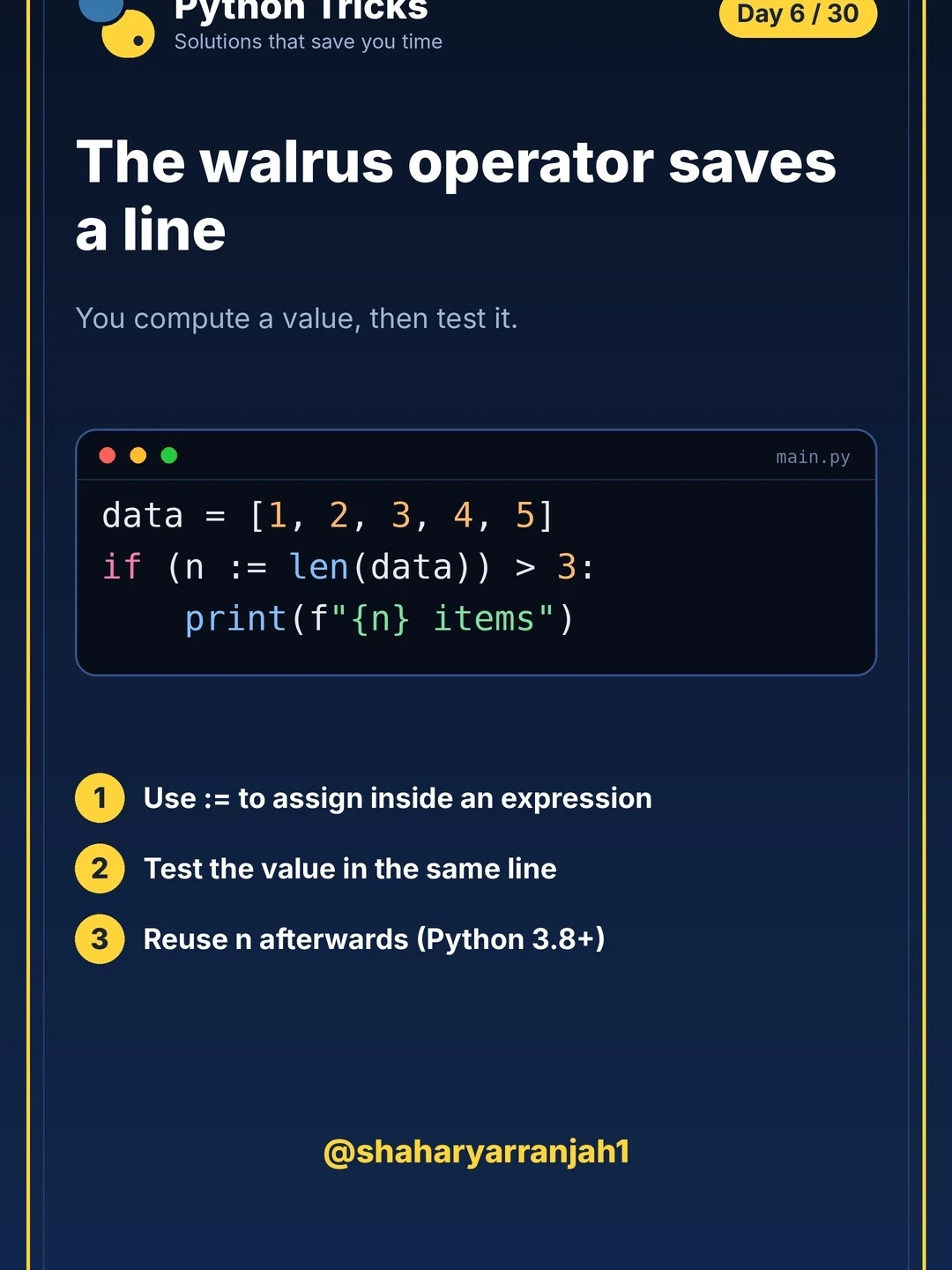
data = [1, 2, 3, 4, 5]
if (n := len(data)) > 3:
print(f"{n} items")
✅ Output:
5 items
🚀 How does it work?
1️⃣ := assigns a value inside an expression.
2️⃣ len(data) calculates the length of the list.
3️⃣ The result is assigned to variable n.
4️⃣ Python checks whether n > 3.
5️⃣ If the condition is true, the code prints the number of items.
🧠 Why should you learn it?
✔ Write cleaner Python code
✔ Avoid unnecessary repeated calculations
✔ Combine assignment and conditional checks
✔ Improve your Python programming skills
📌 Important: The Walrus Operator was introduced in Python 3.8.
🎯 PRACTICE CHALLENGE
What will this code print?
numbers = [10, 20, 30]
if (count := len(numbers)) >= 3:
print(count)
A) 2
B) 3
C) 10
D) Error
👇 Drop your answer in the comments!
📌 Save this Reel for your next Python coding session.
👨💻 Follow @shaharyarranjah1 for daily Python tricks, AI tutorials, Machine Learning, coding tips, and software development.
#Python #PythonProgramming #PythonTips #PythonTricks #LearnPython #Coding #Programming #PythonDeveloper #100DaysOfCode #CodeNewbie #SoftwareEngineering #AI #MachineLearning #DeveloperCommunity #CodeWithShaharyar















Comments